
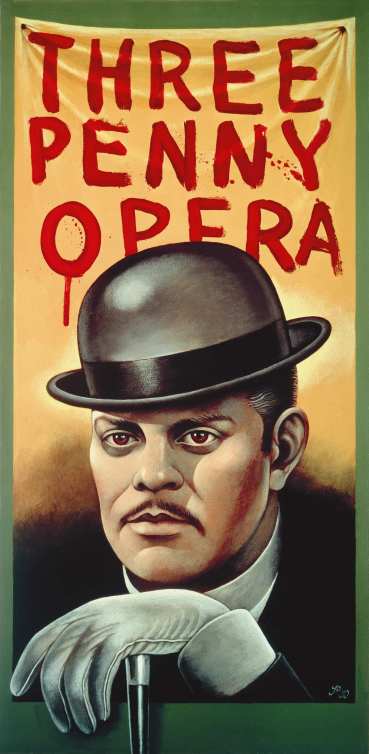
Everyone, even Chris Evans, is seemingly reading The Origins of Totalitarianism for its parallels to today’s political climate. And while many people are eager to put Trump into the role of master of the mob, fewer are interested in the parallels to both those who position themselves as the so-called Resistance, a broadly liberal movement with no political tenets except as a performative reaction towards Trump, and the incipient Left in the United States. The book is filled with few heroes for Arendt (she does seems to have a soft-spot for Dreyfusard Clemenceau), but she rarely is able to find figures who competently combat creeping fascism. Perhaps Arendt’s most vivid image of failure is Arendt’s description of an audience at a performance of the Brecht’s The Threepenny Opera as Germany is in the throes of pre-fascism. As Arendt describes it, Brecht’s work depicts “gangsters as respectable businessmen” and vice versa. This irony, which Brecht as a Marxist proponent of so-called dialectical theater almost certainly wanted to inspire his audience to revolutionary fervor or self-flagellation, actually served the opposite purpose. According to Arendt, “The mob applauded because it took the statement literally; the bourgeoisie applauded because it has been fooled by its own hypocrisy for so long that it had grown tired of the tension and found deep wisdom in the expression of the banality by which it lived; the elite applauded because the unveiling of hypocrisy was such superior and wonderful fun. . . . The only political result of Brecht’s revolution was to encourage everyone to discard the uncomfortable mask of hypocrisy and to accept openly the standards of the mob.” Here irony—even the knowing, well-informed, and thoughtful irony of Brecht—seems dangerous, even irresponsible. It is almost suggest as a weapon for the left so easily turned on itself as to be avoided.
And yet Arendt herself sometimes uses irony as a device—her accounts of minority treaties as a method used to identify groups to expel in the name of identifying groups to protect. Arendt’s history is filled with these historical ironies, where Arendt (and her audience) can look at history and human folly through an ironic lens of retrospect. This historical irony is a safer, less malleable form of irony compared to Brecht’s contemporary. Why is the ironic mode of history acceptable while Brecht’s use tragic? Arendt tells us in The Human Condition, ““It is in the nature of beginning that something new is started which cannot be expected from whatever may have happened before. This character of startling unexpectedness is inherent in all beginnings … The fact that man is capable of action means that the unexpected can be expected from him, that he is able to perform what is infinitely improbable. And this again is possible only because each man is unique, so that with each birth something uniquely new comes into the world.” Brecht thinks he can know his audience, and this expectation of a single response to his play is the key flaw in his irony. He did not expect the unexpected, while Arendt’s historic irony is not undone as failure to recognize it as such.
The tension between these uses of irony helps the curious Arendt reader explore what irony is, and most specifically what irony requires. Why, if she was equally haunted by the eerie image of the avant-garde (used interchangeably with ‘the elites’ in this passage’) laughing at premonitions of their own undoing, did Arendt use irony?The answer could very well be in the structure of irony itself. Irony requires not only a specific audience but a shared worldview or knowledge between ironist and audience. Richard Rorty’s concept of vocabularies—language as the conceptual framework that does not simply help us discover but in fact creates truth and morality—helps elucidate the dynamics of irony. The ironist and her audience must have widely overlapping vocabularies. At its best, irony can be a moment of reaffirming an in-group. Arendt’s ironic moments make us accomplices in readers not only of Arendt but of history. A new intimacy can be felt by readers, even a sense of belonging.
What makes the Brecht example a toxic moment is that it shows the harm of irony when vocabularies are coming into conflict or during a period of wildly shifting of vocabularies, during a crisis of legitimacy. When the mob, the bourgeoisie, and the elite heard “Erst commit das Fressen, dann commit die Moral,” they heard the same words, but their vocabularies (in the Rortian sense) imbued the phrase with very different meanings. Brecht thinks he knows his audience’s vocabularies; he does not. Irony doesn’t breakdown at these moments, but it becomes sinister. It renders the historical victors as knowing, and the losers as pathetic, almost silly. Arendt’s irony about historical events means that in some ways she can guarantee her audience shares a broad post-Naziism vocabulary, even decades later.
Irony stops being constructive when it’s read by someone whose vocabulary strips it of its irony—instead of reading an ironic overstatement of fact with the ironist’s intentions, the overstatement is read in earnest, or as truth. An ironist misunderstanding or misidentifying her audience would create the harmful irony similar to the reception of Brecht in Pre-Hitler Germany. But moreover, in times when there is a great flux in norms, irony becomes a dangerous construction. Vocabularies are shifting wildly overnight, norms beloved by the elite are disappearing. In a Trumpian era, statements that five years ago would seem too ludicrous to be true “the US government is kidnapping children at the border” for instance, are suddenly actual statements of fact. These periods when fascism looms large are particularly unsuited for irony. Irony relies on a stable vocabulary and a stable realm of what is sincere and what is ironic. When we lose our collective vocabularies, the ironist loses control over the reception of their work.
Irony happens to be a popular tool on the left at the moment, in ways that I would argue parallel the uncomfortable position Brecht found himself in. Since 2016 the “irony left” has been held in contrast with the “centrist left” (let’s forget that “irony” is not a coherent political position or that “centrist left” seems like a silly term when we have “left liberal” right here.) The extent to which these are manufactured divisions in the media and not clear political orientations cannot be overstated. This version of the political landscape has graced the pages of Paste Magazine, The Atlantic, and The New Yorker. The irony left finds it footing in podcasts (the most famous of which is Chapo Trap House) and on Twitter (the mechanics of Twitter—the short phrases tweeted out without context, the ability to share these tweets sans context—actually makes it a very bad medium for irony). The irony left is not a particular political stance (although it hews fairly closely to a social democrat platform) but a group of relatively wealthy New Yorkers and the folks that love to laugh at their jokes.
But the pernicious results of this have always been clear in organizing spaces, where irony drains energy and can either confuse or even harm other organizers. In radical organizing spaces, people are ideally coming together to build new, liberatory vocabularies that help render their oppressors into problems to confront. When irony is used within organizing spaces, it creates an in-group (those who get irony) and an out-group. Irony in organizing spaces undercuts the work there.
Moreover, a recent piece on the style site The Cut profiled the hosts of Red Scare (take a moment to wow-whistle at the complete aestheticization of politics here), a podcast that the writer situates on the irony left. The hosts love to critique what they have dubbed “neoliberal feminism,” and that is seemingly enough to earn them a spot on the left. The podcast itself is a mixture of irony and cruelty—it is hard to know when, if ever, we should take its hosts seriously. But it is more concerning than simply handling slippery irony in the case of Red Scare. One of the hosts, Anna Khachiyan, has tweeted in 2015, “Let’s be clear on one thing: I am not and have never been a liberal or a leftist. I’m a cryptofascist, and the “crypto” is being generous.” And yet, The Cut has hailed this woman as a left alternative to Clintonite feminism. When irony becomes de rigeur on the left, it provides powerful cover for fascists to openly shift towards a socialized chauvinism and call it left. The hosts defend the use of the word “retarded” as an important part of their vocabulary, and I’d argue they share vocabularies more with reactionaries than with the left.
So where does that leave irony? I think it leaves Arendt’s own use of irony as fairly well insulated from the charges against contemporary ironists or Brecht. Her own use, versus Brecht’s, is ensconced in a strong reading of history, from a standpoint of decades later. Ironists today will probably be remembered in the best case scenario as a staging of The Three Penny Opera in pre-Hitler Germany—a revolutionary impulse thwarted by historical forces. At worst, ironists today will play a crucial role in undermining left power and bolstering fascism within the US. It is not because they intend to, but because they underestimate the power of the reader or listener. Regardless, these accounts show the limits of irony as a political weapon. It is a device of shared contingency, not one for a fractured and shifting political landscape.
 Political Theory & a Peony